| Birthright Citizenship Resources |
AboutThe Fourteenth Amendment of the U.S. Constitution promises every person equal treatment under the law. Its plain text includes an equal claim of citizenship to all persons born in the United States, regardless of the status or circumstances of their parents---known as birthright citizenship. Protecting birthright citizenship is a commitment to safeguarding equal rights and preserving constitutional values. Birthright Citizenship and AANHPI Legal HistoryThe legal campaign for birthright citizenship and equal protection for those born on U.S. soil are efforts that rest on a historical battle waged over a century ago, including by Asian American litigants. Over 7,000 habeas petitions were filed by Chinese migrants during the Chinese Exclusion era with several cases reaching the U.S. Supreme Court, including that of Wong Kim Ark, whose case guaranteed birthright citizenship for all persons born in the United States. Upon ratification in 1868, Fourteenth Amendment to the United States Constitution, rectified the notorious and wrongly decided Dred Scott v. Sandford case, which previously denied citizenship to Black Americans. In 1898, the Supreme Court in United States v. Wong Kim Ark clarified that the promise of citizenship was available to all born in the United States with very few exceptions. Asian Americans have played a central role in shaping our legal landscape, especially in regard to birthright citizenship. Asian Americans blazed legal trails that still inform the caselaw, and our rights today. These are not just names on one side of the "versus" caption; they were real people whom all Americans should know. As NAPABA argued in its briefs before the U.S. Supreme Court and the U.S. Courts of Appeals for the First, Fourth, and Ninth Circuits, foundational jurisprudence of modern-day immigration law emerged almost entirely from the fight by Asian American migrants to secure rights in the United States. Navigate our resource to read our briefs and learn more about the other precedents involving Asian American litigants. Questions? Please contact our Advocacy and Policy Team at advocacy@napaba.org. Disclaimer: The information provided on this website and in any associated attachments is for informational and educational purposes only and does not constitute legal or other professional advice. It is not intended to create, and receipt of it does not establish, an attorney-client relationship. This information should not be relied upon as a substitute for legal or other professional advice tailored to your specific circumstances and may not be used to avoid penalties under law. Wong Kim Ark
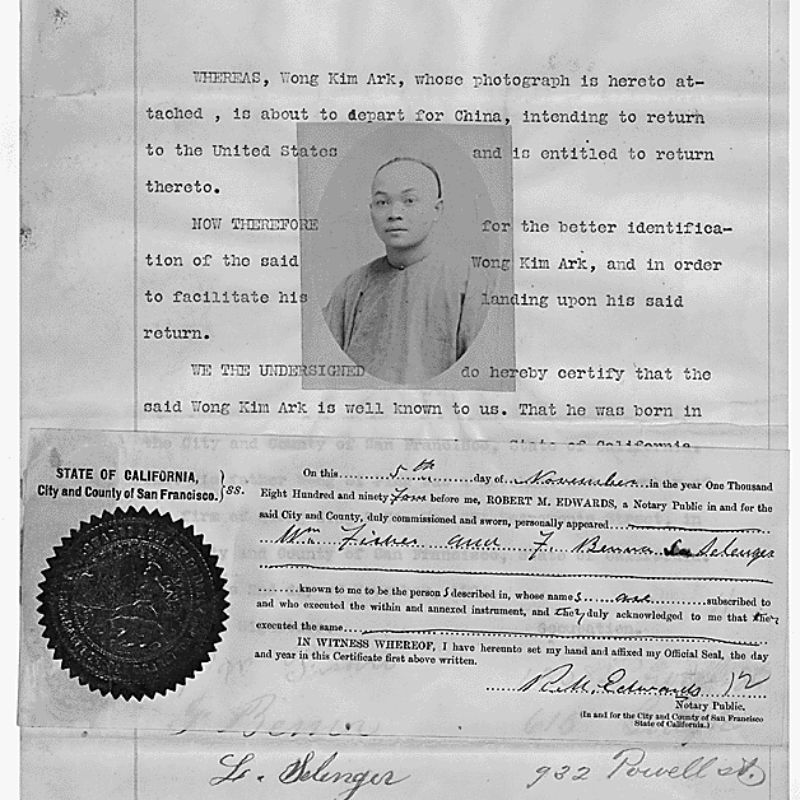
Wong Kim Ark was born in San Francisco in or around 1873 to Chinese-born parents. They migrated to America when there were few restrictions on who could enter the United States. In 1895, after a trip to visit China, Wong was denied re-entry to the U.S. under the Chinese Exclusion Act. Immigration officials claimed that he was not a citizen because his parents were Chinese nationals, and according to them, Wong could not be an American citizen. Wong Kim Ark challenged the government’s position in court, and his case — United States vs. Wong Kim Ark, 169 U.S. 649 (1898) — eventually reached the U.S. Supreme Court. 
In the aftermath of the Civil War, birthright citizenship has been guaranteed by the Fourteenth Amendment to the U.S. Constitution. The amendment addressed Dred Scott vs. Sandford, 60 U.S. 393 (1857), where the Court held that an enslaved person born in the U.S. could never be a citizen. In 1898, the U.S. Supreme Court ruled 6–2 in United States v. Wong Kim Ark that the Fourteenth Amendment's Citizenship Clause confers citizenship to anyone born in the United States, regardless of their parents' background or immigration status. Wong Kim Ark's case confirmed that birthright citizenship extended to all. This ushered in an era that reconceptualized who belonged in America. It expanded the ambit of equality – also guaranteed by the Fourteenth Amendment – by protecting the children of immigrants from being denied citizenship based on their heritage. Wong Kim Ark’s case has had a lasting legal impact, not only for Asian American communities but all communities. At a time when Asian immigrants were excluded from naturalization and faced widespread discrimination, his U.S. Supreme Court victory ensured that U.S.-born children of migrants could not be denied citizenship. Today, as debates over immigration and birthright citizenship continue, the Wong Kim Ark decision remains a crucial safeguard for AANHPI communities (whose populations are comprised of a significant percentage of immigrants) and beyond.
Executive Order 14160
In 2025, the federal government issued Executive Order 14160. Also known as "Protecting the Meaning and Value of American Citizenship," Executive Order 14160 bars the government from recognizing American citizenship for children born to mothers unlawfully present or even lawfully but temporarily present in the U.S. and if their father was not a U.S. citizen or a lawful permanent resident. This undermines the precedent set in United States v. Wong Kim Ark that all U.S. born children are U.S. citizens regardless of the circumstances of their parents. The Executive Order will have disproportionate effects on Asian American populations and other immigrant communities, echoing past discriminatory laws like the Chinese Exclusion Act. If enforced, the order is likely to lead to widespread legal uncertainty, family separations, and bureaucratic chaos. Questions? Please contact our Advocacy and Policy Team at advocacy@napaba.org. Disclaimer: The information provided on this website and in any associated attachments is for informational and educational purposes only and does not constitute legal or other professional advice. It is not intended to create, and receipt of it does not establish, an attorney-client relationship. This information should not be relied upon as a substitute for legal or other professional advice tailored to your specific circumstances and may not be used to avoid penalties under law. NAPABA Birthright Citizenship Amicus BriefsNAPABA has long championed the fundamental principle of birthright citizenship, a cornerstone of civil rights in the United States. In 2015, NAPABA adopted a resolution supporting the widely-held interpretation of the Fourteenth Amendment and rejecting efforts to undermine its guarantees. Beginning in 2025, we have defended the constitutional guarantee of citizenship in court for all individuals born on U.S. soil. Our amicus briefs seek to ensure that our members, the courts, and the public have a stronger understanding of how Asian American legal history has shaped the debates over birthright citizenship and that Asian American and Pacific Islander communities continue to retain the protections guaranteed under the Fourteenth Amendment. These briefs reflect NAPABA’s commitment to safeguarding equal rights, preserving constitutional values, standing against efforts to erode this vital protection, and educating the public on the direct relevance of Asian American legal history in today’s most contentious policy debates. Questions? Please contact our Advocacy and Policy Team at advocacy@napaba.org. Disclaimer: The information provided on this website and in any associated attachments is for informational and educational purposes only and does not constitute legal or other professional advice. It is not intended to create, and receipt of it does not establish, an attorney-client relationship. This information should not be relied upon as a substitute for legal or other professional advice tailored to your specific circumstances and may not be used to avoid penalties under law. Additional ResourcesCasesNAPABA's amicus briefs on birthright citizenship, as well as the federal government’s arguments, rely on many landmark cases involving Asian American litigants that are foundational to the body of United States immigration and civil rights jurisprudence. During the restrictive and exclusionary period of the 1800s, Asian Americans brought over 7,000 habeas petitions with several, such as Wong Kim Ark’s, reaching all the way to the Supreme Court of the United States. These cases are integral not only in explaining the Asian American experience, but for a full understanding of American history. These are some of the cases involving Asian American litigants that have been cited to during the course of the birthright citizenship litigation.
Articles
Recordings
Modern American History Forum: The Historical Paths to and from Wong Kim ArkThe journal Modern American History, features several leading U.S. historians (including Professor Hardeep Dhillon, who previously appeared on a NAPABA plenary session on citizenship and identity, and Professor Beth Lew-Williams who headlined the NAPABA Birthright Supreme Court preview) in a forum exploring contemporaneous historical and legal issues surrounding birthright citizenship and Chinese migration. See: Hardeep Dhillon, Beth Lew-Williams, Maddalena Marinari, Heather Ruth Lee, Anna Pegler-Gordon. "The Historical Paths to and from Wong Kim Ark." Modern American History 8, no. 3 (2025): 355–58. (Corrigendum Mar. 2026)."
Additional Briefs of Note
Questions? Please contact our Advocacy and Policy Team at advocacy@napaba.org. Disclaimer: The information provided on this website and in any associated attachments is for informational and educational purposes only and does not constitute legal or other professional advice. It is not intended to create, and receipt of it does not establish, an attorney-client relationship. This information should not be relied upon as a substitute for legal or other professional advice tailored to your specific circumstances and may not be used to avoid penalties under law. |
4/27/2026NAPABA Statement in Response to Shooting at White House Correspondents’ Association Dinner
2/25/2026NAPABA Leads Broad Coalition to Defend Birthright Citizenship in the U.S. Supreme Court
2/19/2026NAPABA Welcomes NKABA and CALA OC
1/23/2026NAPABA Supports the Language Access for All Act of 2026
1/21/2026NAPABA Applauds the Appointment of Justice Sanjay T. Tailor to the Illinois Supreme Court
5/19/2026 » 5/20/2026
NAPABA Lobby Day
5/19/2026
NAPABA Congressional Reception
11/12/2026 » 11/15/2026
2026 NAPABA Convention
11/4/2027 » 11/7/2027
2027 NAPABA Convention
11/9/2028 » 11/12/2028
2028 NAPABA Convention
1612 K Street NW, Ste.300
Washington, DC 20006

© 2015 - 2026 National Asian Pacific American Bar Association | The NAPABA and the NAPABA logo are Registered in the U.S. Patent and Trademark Office